Case study — SaaS
One dataset, four regulators
An ESG platform needed companies to enter emissions data once and report to four disjoint regimes — EU CSRD, Singapore IFRS S2, UAE Federal Climate Law, and California SB 253/261 — without redoing the work per framework. We built the collect-once data model and the jurisdiction-aware reporting engine behind it.
Product capabilities
- regulatory regimes from one dataset
- 4
- confidence tiers on every figure
- 3
- Scope 3 supplier questionnaire
- ~15 min
The challenge
The 2026 sustainability deadlines do not arrive as one requirement. A company in scope for the EU's CSRD may also owe a report under Singapore's IFRS S2, the UAE's Federal Climate Law, and — if it does enough business in California — SB 253 and SB 261. Each regime wants its own format, and the naive response is to run the whole data-collection exercise once per framework.
The hardest data to collect is Scope 3: the emissions embedded in a company's suppliers. It usually begins life as a spend-based estimate, and upgrading it to something measured means extracting real numbers from suppliers who have no account, no training, and no incentive to spend an afternoon in a portal.
And every figure carries audit exposure. A reviewer — internal, external, or a regulator — has to see where a number came from, which means provenance cannot be an afterthought reconstructed the week before the audit.
The approach
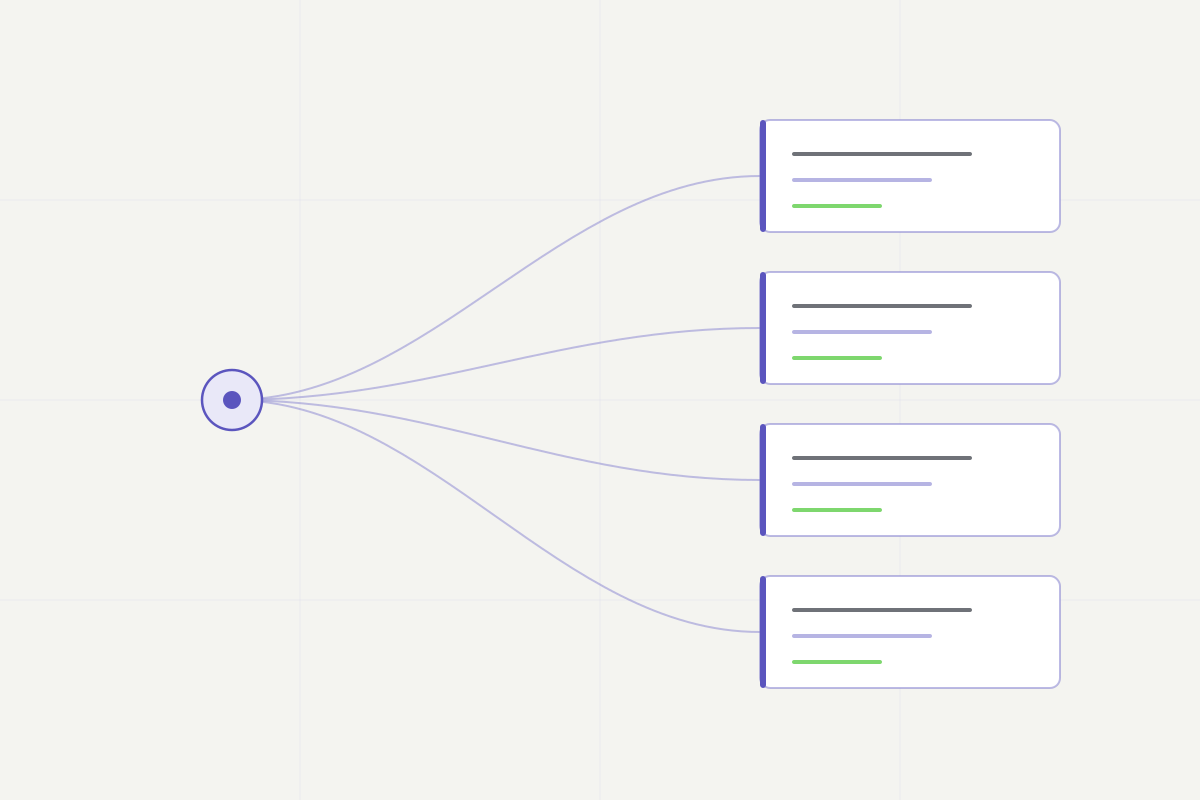
The platform is built around a single canonical data model: fuel, electricity, spend, and travel are entered once, then mapped to each framework's requirements. Collect-once is the whole design premise — the same dataset drives the CSRD, IFRS S2, UAE, and California reports, so adding a jurisdiction is a mapping exercise, not a re-collection.
Every number carries a confidence tier — Measured, Calculated, or Estimated — with a link to its supporting evidence. That turns the audit conversation from “trust this spreadsheet” into “here is the provenance of each figure,” and it lets a company show exactly which parts of its footprint are hard data and which are still estimates.
Scope 3 runs through a passwordless mobile questionnaire designed to be finished in minutes, so a supplier converts a spend-based estimate into measured data without an account or a training session. The whole history is immutable and tamper-evident, which is what makes the output audit-ready rather than audit-hopeful. The application is built on Next.js.
The result
A company in scope for several 2026 frameworks can answer all of them from one round of data entry, with a defensible audit trail behind every figure — instead of running parallel compliance projects that each re-collect the same data.
Because confidence and provenance are attached at the point of entry rather than reconstructed at audit time, the reporting exercise produces its own evidence file as a byproduct — which is the part a reviewer actually asks for.
Facing a similar problem?
Tell Mukul Chauhan about your website, mobile app or startup idea. We’ll discuss the scope, budget in INR and next steps.