
Case study — Healthcare
−71% patient intake handling time
A 14-clinic outpatient network was drowning in faxed referrals. A HIPAA-conscious LLM pipeline — with a human reviewing every record — cut intake handling time 71%.
Client
Healthcare provider · Multi-clinic
Industry
Services
Timeline
20 weeks · team of 5
Results
- intake handling time
- −71%
- field-level extraction accuracy
- 96%
- records human-reviewed
- 100%
Illustrative figures from anonymized engagement profiles.
The challenge
The client, a multi-clinic healthcare provider with 14 outpatient locations, receives most of its referrals the way American healthcare still does: as faxes, scanned PDFs, and photographed paper forms. Intake coordinators re-keyed each one into the EHR by hand — demographics, insurance, diagnosis codes, referring provider — at a median of 18 minutes per referral, against a backlog that regularly stretched past four days.
The backlog wasn’t an inconvenience; it was clinically meaningful. Slow intake pushed out time-to-first-appointment, and no-show rates climb with every day a patient waits. The provider had already trialed an off-the-shelf “AI intake” product and abandoned it: accuracy was unverifiable, PHI handling was opaque, and their compliance officer — reasonably — refused to sign off on a system nobody could audit.
Their requirements were strict and, in our view, correct: no PHI leaves BAA-covered infrastructure, no patient data enters any model’s training set, a named human stays accountable for every record that reaches the EHR, and the audit trail satisfies both HIPAA and their malpractice insurer.
The approach
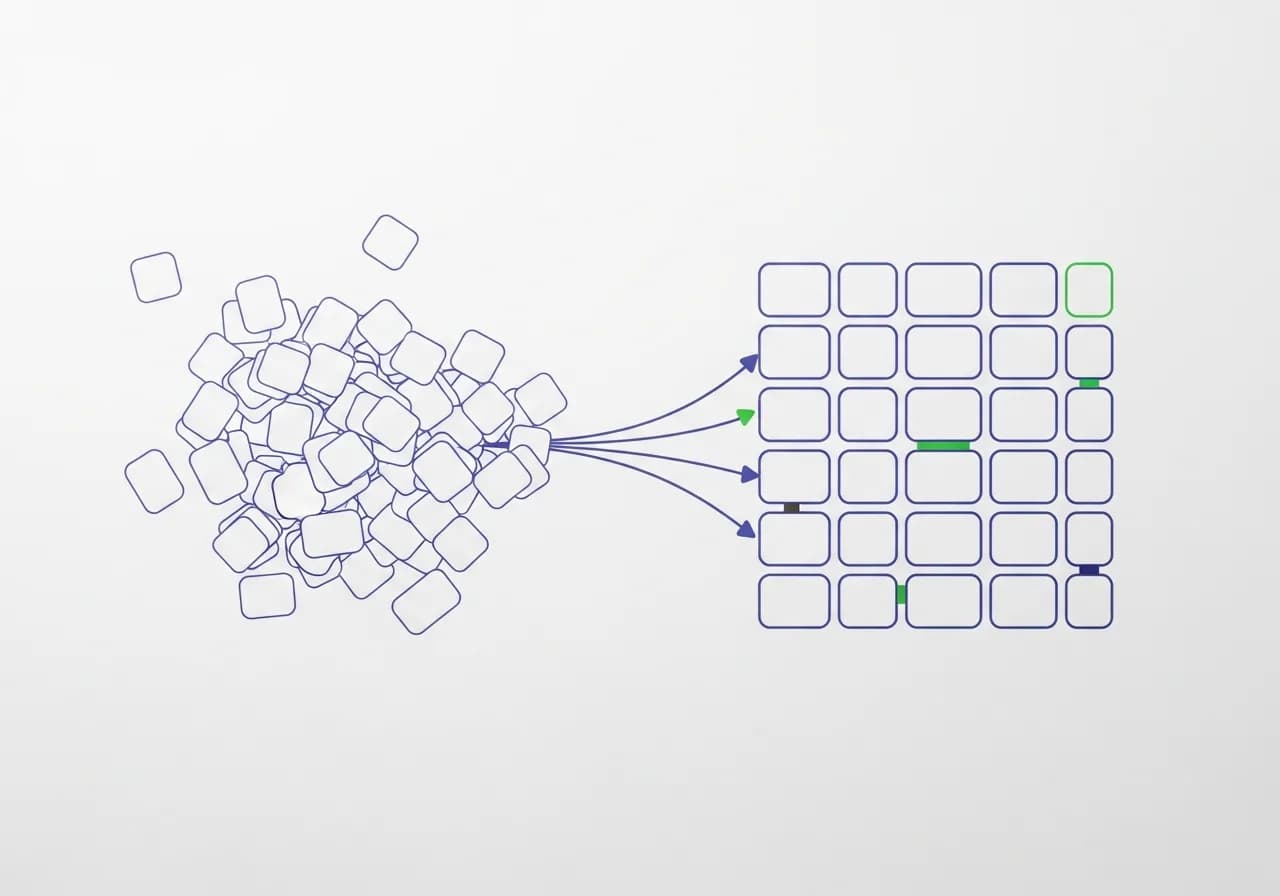
We designed the pipeline around review, not around magic. Incoming documents are classified and OCR’d, then a large language model running inside a BAA-covered environment extracts fields into a strict schema — every value validated against type, code set, and plausibility rules, and every one carrying a confidence score plus a pointer back to its exact location in the source document.
Nothing writes to the EHR on its own. Extracted records land in a review queue where coordinators see each field beside its highlighted source snippet, so confirming a value takes one glance and one keystroke instead of finding it and re-typing it. High-confidence fields need a confirmation; low-confidence ones demand attention first. Verified records then post to the EHR over HL7 FHIR — no swivel-chair data entry.
The dedicated team of five embedded with the provider’s IT group for the whole build, because half the work was governance: prompts and model versions pinned and change-controlled, PHI excluded from logs and traces, per-field audit records of what the model proposed and what a human approved, and a monthly accuracy audit against a hand-labeled sample so drift shows up in a report before it shows up in a chart.
The result
Median handling time per referral fell from 18 minutes to just over 5 — a 71% reduction — and the four-day backlog cleared within six weeks of go-live. Field-level extraction accuracy stands at 96% before review, and every record that reaches the EHR still carries a named human approval, which is exactly how the provider’s compliance officer wants it.
Time-to-first-appointment dropped by three days on average, and intake coordinators moved from data entry to exception handling and patient callbacks. The system has since passed both an internal HIPAA review and the malpractice insurer’s assessment without findings.
“Every vendor promised automation. QuantmHill was the first to lead with the audit trail — and that’s why this is the one system our compliance officer actually approved.”
Facing a similar problem?
Tell us where you're headed. We'll reply within one business day with an honest read on whether we can help.